
A small update
This past month has been about healing—about quiet and rest and remembering how to move fingers and toes so that the remembering of the rest of a body can trickle into awareness. Everything has felt like too much, and so that has torn through life, leaving a trench in its wake that is an emptiness or a scar or both.
In the years since March of 2020, I have been privileged in that I had a home to retreat to and hide away within, so COVID hadn’t had the opportunity to find me. I’m still careful, and when I think about my life now, it is much smaller still than it had been. In some ways, this is better—my innate being calls for a quieter and slower pace of life than I had been allowing. I held a fear that if I slowed down, I would never start back up again. That has proved to be true in some cases, but I am also surprised to discover that where it is true, I am sometimes not so sad to have set that part of my life down.
Last month, COVID did find me after all of this time, and I was sick through most of October and now recovering through November. I was luckier than many, but unlucky as well. Chronic illness already pesters the soft tissues of my body, and nothing has settled into a managed pattern since being sick. I am often very tired. I am often distracted beyond reason by the persistent loud ringing in my ears. I often can’t think through the fog. But this is also what it’s like when the illness that walks with me every day decides to get angry with me, and so it has been difficult to decipher how much of my current lethargy is chronic from before or chronic after. I, like many before me, have begun to see the timeline of my life as marked (even more so than before) by before COVID and after.
Early in the infection, I read information online about what this most recent variant’s symptoms look like. I was struck by the language specific to the effect of the virus on the inner ear—that it invades. Invasion sounds so malicious! I didn’t realize that tinnitus could be a small war of bells inside my own head. I didn’t realize that I would be in another field of battle with my body for my precious energy and attention. The other things—the fatigue and brain fog—are old enemies of other illnesses. I was prepared for them, and while unwelcome guests, I at least had a mental space cordoned off for just myself into which I could retreat. But you can’t escape sound, much like you can’t escape pain. For a person extremely sensitive to auditory sensory input, sound can very much be pain.
Things have been improving, though, albeit slowly. I still feel very lucky, and even more fortunate in the space I have had to just be unwell. I was able to complete an edit on a manuscript and participate in Summer Brennan’s Essay Camp which was revitalizing both mentally and emotionally. I am here, now—returning to this space to say hello.
There is a stirring in my chest and behind my eyes that I know hearkens to awakening after lying dormant. It has been like lying face down with your forehead pressed into a pillow; that spot in the center of your brow between your eyes feels the fiber of the pillowcase as a warm sort of fuzz. Your eyes are pressed closed, gently yet firmly, by the cushion that elevates into empty spaces with the compression of your head. Now imagine that warm fuzziness on the forehead and weight in the eyes follows you wherever you go—still dark, still with a sense of heaviness that comes from laying face down, a position that does not really allow for anything but surrender to the pull of gravity. Even your limbs feel weighted. It is difficult to see around the constant vice-like warmth, it is difficult to think through the mounting pressure (not so gentle as time goes on) in your eyeballs and the inability to focus clearly.
Most of my days are filled with that fuzzy wad pressed behind my eyes and into the front of my brain; this is what can lead to months of lying fallow. But the stirring, the parting of the wool that has been left in my mind to let some light back in also always comes. The darkness is not for forever. Neither is the light, but it’s less important and painful to acknowledge that when I can also say, “No, but the dark isn’t forever because the light will come again.”
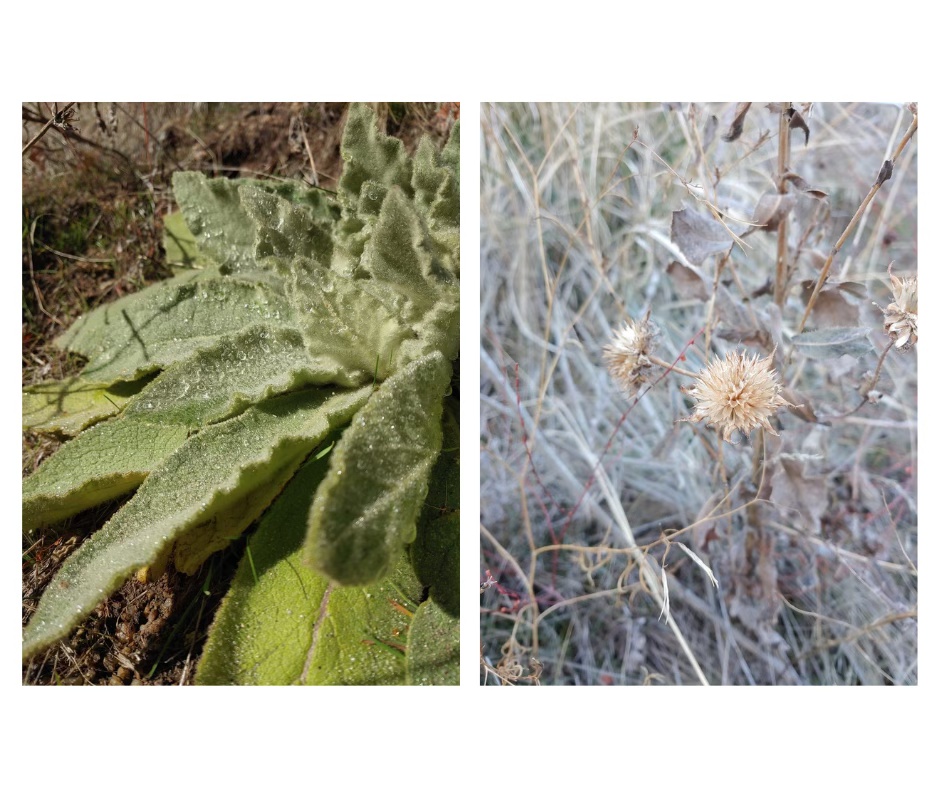
Last week, I went on a hike with my sister and niece. It was an easy trail, and my first excursion outdoors since bedrest, and I was struck by the sheer beauty of the winter desert. It has snowed intermittently and very briefly in these last weeks of November, and the lamb’s ear and bitterbrush were covered in massive frozen drops of water that glinted in the morning sun. Everything was covered in dancing lights, and I stood still, listening to the sound of Dry Creek (misnomer) babbling along the rocks at the bottom of the gorge and my niece singing the following-the-leader song I had taught her on the narrow part of the path. Red-tailed hawks shrieked overhead, and the lichen-covered boulders cast long morning shadows that made the path feel like it was winding through an ancient henge or a labyrinth. It was overwhelming to remember the outside world exists, to appreciate a small, simple moment so profoundly. It still brings tears to my eyes.
***
“Things Shouldn’t Be So Hard” by Kay Ryan, from The Niagara River, (Grove/Atlantic, Inc. 2005)
A life should leave
deep tracks:
ruts where she
went out and back
to get the mail
or move the hose
around the yard;
where she used to
stand before the sink,
a worn-out place;
beneath her hand
the china knobs
rubbed down to
white pastilles;
the switch she
used to feel for
in the dark
almost erased.
Her things should
keep her marks.
The passage
of a life should show;
it should abrade.
And when life stops,
a certain space—
however small —
should be left scarred
by the grand and
damaging parade.
Things shouldn’t
be so hard.
 Malorie Nilson
4 responses to “Things Shouldn't Be So Hard”
I relate very much. My health has never been particularly what other people would call “good” but COVID was a major turning point for me. I haven’t had an increase in tinnitus, but I’ve been dealing a lot with the sort of vertigo that comes from crystals coming loose in your ear and rolling around (bppv). Much sympathy for you – it’s hard. Glad you are starting to feel some recovery.
LikeLike
Thank you for your kind words, and I am also sending my sympathy. Vertigo is so disorienting. That has become less of a problem for me, though it has also been present post-COVID. It still feels just wild the noticing of all of these little things.
LikeLike
I loved this vulnerable piece so much. We need to read and listen to more real stories like this to let each other know that we’re not alone.
LikeLike
Thank you 🙏
LikeLike